Phage at Beliaghata
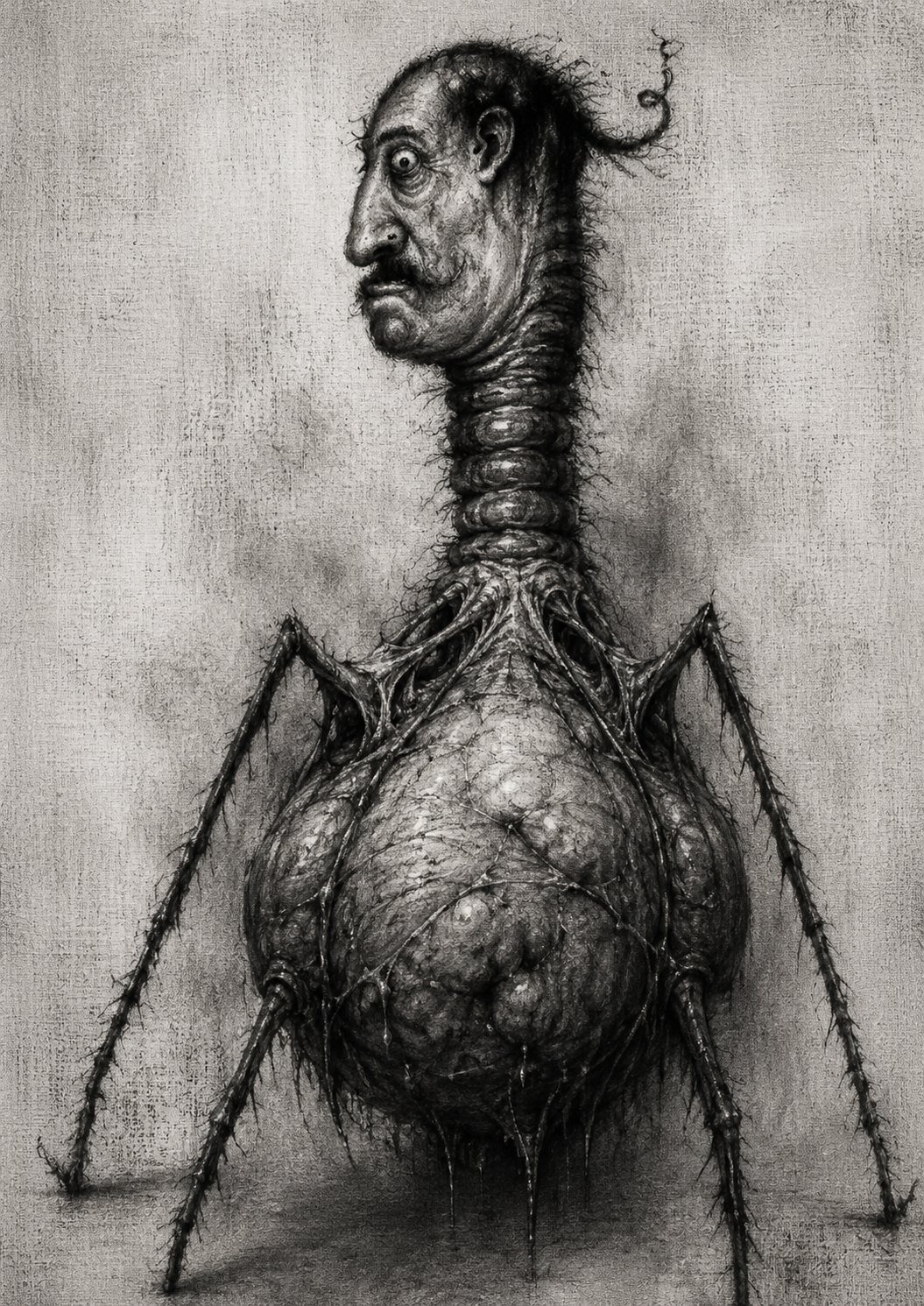
THIS IS A WORK OF FICTION
When Arka Sen woke, he had no hands.
The fact arrived before fear, as facts often did in his profession, neatly and without manners. He tried to lift his right arm from the pillow and instead felt six thin attachments flex against the air, each ending in a delicate hook, absurdly sensitive, as if the room itself had grown fur. The ceiling fan turned above him with a flat clack-clack-clack. Beyond the barred window, Beliaghata was already arguing with the morning.
A fish seller dragged his aluminum tub through the lane, calling out bhetki in a voice cracked by sleep and bidi. Someone below cursed the municipality because overnight rain had lifted the drain water into the street and left a gray ribbon of scum against the parked scooters. From the tea stall at the corner came the wet slap of bread on tawa, the hiss of milk rising in a dented pan, the first political quarrel of the day blooming like fungus. A tram bell sounded far off, elderly and unconvinced. On the wall opposite Arka’s window, a poster for a coaching center promised NEET success in six months, which was modern Bengal’s preferred form of magic: parents feeding their fear into fees, children becoming rank-bearing goats for sacrifice.
Arka tried to say, “Ma?”
No sound came. Not from a throat. He had no throat.
He saw his room differently. Not with eyes. The world stood around him in pressure, salt, heat, charged surfaces. The damp patch over the almirah glowed with bacterial weather. The leftover tea in the cup beside his bed was not brown liquid but a crowded city of membranes and hunger. On the floor lay his spectacles, irrelevant now, their cracked left lens reflecting a shape on the pillow.
A head like a glass seed. A narrow tail. Six jointed legs.
He was a bacteriophage.
For a while he did not panic. The mind, loyal little clerk, kept filing papers though the office had burned down.
Bacteriophage: virus that infects bacteria. Protein capsid enclosing nucleic acid. Tail fibers for attachment. Inject genome, hijack cell, replicate, lyse host.
His own lecture notes returned to him in fragments, not as memory but as insult.
Then his mother knocked.
“Arka? Are you up? The milkman is shouting like he owns shares in our family.”
The door was not latched. He had forgotten, as usual. Since Baba’s death, his mother had acquired a habit of entering without waiting, as if grief had given her duplicate keys to every room.
Arka threw himself from the pillow.
Not threw. Tumbled. He hit the bedsheet, bounced, skittered between two books, and wedged under a sock. The room towered, terrible and comic. A fallen copy of Molecular Genetics rose beside him like a courthouse. Dust was boulder, hair was rope, a dead mosquito was a collapsed crane.
The door opened.
His mother, Sharmila Sen, entered holding two cups of tea and wearing the expression of a woman prepared to scold poverty personally. Sixty-four, thin as a matchstick but with eyes that still defeated shopkeepers, she looked at the empty bed and said, “Again bathroom without slippers. Then fever. Then drama.”
Arka pressed himself into the shadow of the bed leg.
She put the cups down. Her knees cracked as she bent to pick up his spectacles.
“Arka?”
He wanted to run to her. He wanted to say, Ma, I am here, under the bed, approximately two hundred nanometers wide in dignity if not in exact scale, please do not sweep.
She looked at the pillow.
On it lay a faint gray smear shaped like a man after rain.
His mother touched it.
The smell came through the air like a command.
Human skin. Sweat. Tea. Mustard oil from her hair. And underneath, deep in the damp cave of her breath, a sour-green bloom Arka recognized before thought could dress it. Klebsiella. Resistant strain. The enemy with a soft capsule and no shame.
His mother coughed.
Only twice.
But in those two coughs Arka heard the ICU.
Baba on the hospital bed at NRS, eyes yellowed, lips cracked, one hand gripping Arka’s wrist with a strength that had embarrassed both of them. The junior doctor saying, “We are escalating.” Escalating to what, Arka had wanted to ask. Heaven? The pharmacy boy running for meropenem. Then colistin. Then nothing. A lifetime of pills from neighborhood counters, every fever greeted by antibiotics as casually as muri, every cough treated like national emergency, had helped build the little kingdom that killed him.
Arka had studied antibiotic resistance because of Baba. That was the noble version. The truer version was uglier. He had studied it because he could not bear that something invisible had beaten him while he stood there with degrees, citations, English, and helpless hands.
Now he had no hands at all.
His mother turned toward the table. Beside the tea cups lay his lab notebook, open where he had left it at 2:13 a.m.
Subject: environmental phage cocktail active against KPN-BG17.
Notes: high lytic activity. Unexpected stability in mammalian serum. Further testing required. DO NOT SELF-HANDLE.
Beneath that, in red ink, a line he did not remember writing:
THE HOST IS NOT THE BODY. THE HOST IS THE GUILT.
He heard footsteps in the corridor. Slow, slippered, reluctant.
“Boudi?” called Parimal-da from downstairs. “Your son’s cycle is blocking the landing again. Nobel Prize people also must obey fire safety.”
“He is not Nobel Prize,” Sharmila called back. “He is not even married.”
“Same thing nowadays,” Parimal-da said. “Both require foreign funding.”
Under the bed, Arka trembled with all six tail fibers.
He had to reach the lab.
The thought appeared complete. Not hospital, not police, not temple. Lab. The answer, if there was one, lay among sewage samples, Petri dishes, and Professor Nirmal Chatterjee’s locked freezer at the institute near Moulali, where Arka had spent five years turning Calcutta’s drains into data.
He moved by touching surfaces, springing, gripping, falling. A bacteriophage was not meant to cross mosaic flooring. He made it to his canvas bag only when his mother left the room to argue with the milkman over two rupees. The bag hung from a chair. He climbed a frayed thread, slipped twice, and landed inside among papers, a tiffin carrier, and the glass vial he had brought home against protocol.
The vial was broken.
A crust of dried sample clung to the inside of the bag.
Memory opened.
Last night: rain hammering the lab windows. Mili at the door, soaked, angry.
“You took the Beliaghata sample home?” she had said.
Mili Basu was not his wife. That had ended before it began, like many Bengali romances smothered under salary slips. She was a physician now at the fever ward, efficient, tired, hair always escaping its clip as if making a small jailbreak.
“I need to rerun the assay,” he had said.
“At home?”
“Incubator failed.”
“Arka, don’t lie badly. It is painful for observers.”
He had shouted then. Something about urgency. About waiting. About patients dying because committees wanted signatures in triplicate. She had said his father was not inside every culture plate.
Then Professor Chatterjee had entered, calm as a sealed envelope.
“Enough,” he said. “Both of you.”
After that there was tea. A metallic taste. Mili leaving first. Chatterjee’s hand on Arka’s shoulder.
“You want to save everyone,” the professor had said gently. “That is a form of vanity. Attractive in youth, dangerous in middle age.”
Then blankness.
Now the bag lifted.
His mother had returned and was tidying, which in Bengali households meant moving objects from known chaos to unknown chaos.
Arka clung to the inner seam while the world swung. He heard her mutter, “Thirty-four years old, PhD not finished, hair falling, no proper job. But bacteria will listen to him.”
The bag dropped onto the chair. Arka struck the tiffin carrier and felt, through metal, the warm thunder of his mother’s cough again.
Klebsiella.
He did not understand how he could know. A phage recognized host by surface structures, by lock and key at a scale where longing and chemistry were the same thing. Somewhere inside Sharmila Sen, bacteria were dividing in the wet dark. Each carried resistance genes like small ancestral properties, passed down with the smugness of landlords.
He could attach.
He could enter.
The idea sickened him, though he no longer had a stomach. To save her, he would have to go inside her.
His mother picked up the tea.
He leapt.
There are heroic leaps in epics, monkeys crossing seas. This was not that. This was a speck launching itself toward a cup of overboiled tea in a damp Calcutta bedroom while a mother complained about milk.
He landed on the rim, slid, caught, and dropped into the tea.
Heat tore through him. Milk proteins swarmed like pale ghosts. Sugar. Tannin. Dust from the room. He did not dissolve. The phage body held. The sample had been stable in mammalian serum. Tea, apparently, was less challenging than peer review.
His mother drank.
Darkness took him into warmth.
The human body was not a temple. It was a bazaar after rain. Crowded, fragrant, badly governed, full of negotiations conducted at speed. Arka passed down a flood of tea and saliva, through acid that burned but did not break him, into channels where mucus dragged like monsoon silt. Cells loomed, not as objects but as territories marked do-not-enter. Immune sentries nosed past. He was too strange, too small, perhaps too newly made to trigger alarm.
Then he found them.
Klebsiella pneumoniae.
Plump rods in a slick capsule, gathered along inflamed tissue like men at a para club table, confident because they had survived everything before. Arka touched one with a tail fiber.
Recognition was intimate. Horribly intimate.
He attached.
His tail contracted. His genome shot forward.
For one ecstatic second he was inside the bacterium, not as visitor but as instruction. Make me, said his body. Make me until you burst.
The bacterium obeyed.
So this was hunger.
Not eating. Commanding.
Copies assembled. Heads filled. Tails sprouted. Enzymes chewed the wall. The cell burst open and released him as many.
Arka was still himself and not himself. A hundred versions of his panic scattered through his mother’s infection. He felt them attach, inject, bloom. Bacteria ruptured in silent flashes. Resistance genes spilled like gossip into fluid and became nothing.
His mother coughed once more, then breathed easier.
Relief nearly destroyed him.
Then, among the dying bacteria, he found something that did not belong.
A marker sequence.
Not natural. Engineered.
He knew the signature because he had designed part of it, months ago, as a harmless tracking barcode for lab strains. It should not be inside bacteria from his mother’s lungs.
Arka pulled himself, or the portion of himself that still made decisions, away from the feast.
The lab.
He had to reach the lab.
Getting out of a mother was not a problem covered in doctoral coursework. He rode breath upward, clinging to aerosol, expelled in a cough she politely turned into her anchal. He landed on cotton, crawled through fibers, and dropped onto the floor when she shook the cloth near the balcony.
Outside, Beliaghata had become a wet machine of errands. Schoolchildren stepped over puddles with the solemn disgust of minor aristocrats. An auto-rickshaw coughed black smoke. A medicine shop opened its shutters and immediately sold antibiotics to a man who said only, “Throat-e jhal jhal,” as if the throat were a legal authority requiring appeasement.
Arka crossed the lane by accident and terror. A raindrop struck beside him like a bomb. A cycle tire hissed overhead. He clung to the underside of a courier’s shoe and traveled three crossings in a universe of rubber, mud, betel spit, and devotional songs from passing taxis. At Sealdah crossing the crowd thickened, feet falling like weather. Calcutta did not need monsters; it had pedestrians.
He reached the institute near noon, stuck to the damp cuff of a lab attendant named Gopal, who had once borrowed five hundred rupees from Arka and repaid it in mangoes.
Inside, the building smelled of phenyl, agar, old paper, and ambition gone sour. Research institutes in Bengal had a particular sadness: brilliant people trapped under tube lights, producing world-class complaints and underfunded miracles in equal measure. The corridors displayed framed photographs of ministers inaugurating equipment that no longer worked.
Gopal entered Lab 3.
Mili was there.
She sat beside the biosafety cabinet, face pale, eyes ringed. Her left hand was bandaged. Professor Chatterjee stood near the locked freezer, speaking softly.
“You should not have come,” he told her.
“You called me,” she said.
“I called to ask whether Arka contacted you.”
“You said he was missing.”
“He is missing.”
“He is dead?”
Chatterjee removed his glasses and polished them with the end of his lab coat. He was sixty, handsome in the dry way of old professors who had survived committees, betrayals, and their own students. Everyone liked him because he never raised his voice. In Bengal, this is often mistaken for virtue.
“I don’t know what Arka is,” he said.
Mili’s laugh broke. “That is a sentence you should not say before lunch.”
Arka dropped from Gopal’s cuff onto the bench. The movement drew no human eye. He crossed toward his notebook, open under a glass paperweight.
The pages were not as he remembered.
There were entries in Chatterjee’s handwriting.
Trial 1: murine model successful.
Trial 2: primate tissue culture unstable.
Trial 3: human exposure candidate required.
Below that:
A.S. suitable. High guilt fixation. Prior bereavement. Strong host-target identification.
Mili said, “You drugged him.”
“I sedated him,” Chatterjee said. “He was already contaminated.”
“You contaminated him.”
“I gave him the choice in conversation many times.”
“That is how professors confess now? By footnote?”
Chatterjee sighed. “You work in the ward. You know what is coming. Pan-resistant infections. Neonates dying of organisms we used to laugh at. Surgeons praying over pus. We are standing before a locked door while bureaucrats debate paint color.”
“So you made him into a key?”
Arka touched the page with one fiber.
The paper carried dried droplets. Tea. Last night’s tea.
He saw it now: Chatterjee’s hand placing the cup near him. Mili turning away to answer a call. The professor saying vanity. Attractive, dangerous. The tea tasting metallic because it carried the engineered phage complex and something else, something built from Arka’s own cultured cells, taken during routine “immunology baseline” weeks ago.
Not transformation by curse.
By experiment.
His grief had not made him monster. Someone had noticed the grief and used it as laboratory equipment.
Mili stepped toward the freezer. “Open it.”
“No.”
“Open it, sir.”
Chatterjee’s gentleness thinned. “Inside are samples that could change medicine.”
“Inside are crimes.”
“Medicine is mostly crimes that worked out and were renamed.”
“Arka trusted you.”
“Yes,” he said, and for the first time his voice shook. “That is why he may survive.”
Mili’s bandaged hand trembled. Arka sensed heat there. Not fever. Infection. Her palm had been cut, perhaps on the broken vial last night. Under the gauze bloomed another colony.
Staphylococcus aureus.
Not his target.
Still bacterial. Still vulnerable.
Hunger stirred.
He hated it.
Mili turned suddenly toward the bench. Her eyes narrowed. She had always been good at noticing what did not fit: a mislabeled tube, a patient’s silence, Arka’s lies.
The notebook page moved.
“Arka?” she whispered.
Chatterjee followed her gaze.
Arka lifted his tail and struck the paper, once, twice, three times. Not letters. A rhythm.
Mili went white.
In their first year, when both were too poor for restaurants and too proud for canteen credit, they had tapped messages through the library table during seminars.
Three taps meant: I am here.
Mili covered her mouth.
Chatterjee leaned close, and wonder lit his face so nakedly that Arka almost pitied him.
“Extraordinary,” the professor whispered. “Continuity of cognition.”
Mili picked up a glass slide.
“Don’t,” Chatterjee said.
She placed it gently before Arka like a bridge. “Come.”
He climbed on.
Her hand smelled of antiseptic, latex, and fear. Beneath the bandage, staph multiplied in golden clusters. He felt the surface proteins calling to parts of him that did not exist yesterday.
“Can you understand me?” she asked.
He tapped once.
Yes.
Her eyes filled, but she did not cry. Doctors cried in bathrooms, if at all.
“Did he do this?”
One tap.
Chatterjee said, “Mili, listen. He has already cleared his mother’s infection.”
She froze. “How do you know that?”
The professor smiled sadly. “Because I placed BG17 in her inhaler cartridge last week.”
For a moment even the incubators seemed to stop humming.
Mili struck him.
The sound cracked across the lab. Chatterjee stumbled against the freezer, hand to cheek, more offended than hurt.
“You infected his mother?” she said.
“To create an immediate therapeutic drive.”
“You killed his father in front of him again.”
“I saved his mother. Ask him.”
Arka’s legs weakened. He had no blood, but something in him drained away.
Baba had died because bacteria had become stronger than drugs. Ma had been infected because Chatterjee wanted Arka to become stronger than bacteria. The professor had turned grief into a leash.
Chatterjee pressed a key into the freezer lock. “You think me cruel because you still believe clean hands save lives. They don’t. Hands are never clean. Not in wards, not in labs, not in families. Only outcomes matter.”
The freezer opened.
Inside were racks of vials labeled with patient codes. Dozens. Hundreds. Neonatal sepsis isolates. Burn ward isolates. ICU sputum. Sewer phages. Human serum adaptations.
And one rack labeled: AS-LINEAGE.
Arka understood. He was not singular. He was seed stock.
Mili saw it too.
“No,” she said.
Chatterjee moved faster than either expected. He seized her injured wrist. She gasped. With his other hand he reached for a syringe lying prepared on the tray.
“I am sorry,” he said. “Truly. But she is infected already. He will treat her. Then we will observe transmission.”
Arka jumped.
He landed on Mili’s bandage.
The staph smell engulfed him.
He could save her hand. He could prove Chatterjee right. He could become the obedient miracle, moving from wound to wound, mother to Mili to ward to city, a cure that multiplied by violation. No more waiting for approvals. No more bodies lost to resistant bacteria. No more sons holding fathers while antibiotics failed.
He attached to the first staph cell.
The fit was imperfect. Pain rang through his structure. His engineered body preferred Klebsiella, but hunger was inventive. He forced entry.
Inside, the bacterium resisted. Wrong receptor, wrong machinery. Arka pushed his genome forward anyway. Something tore. Copies began, malformed, furious. The cell burst and released not many clean Arkas but a cloud of broken possibility.
The bandage darkened.
Mili screamed, not from pain but from seeing Chatterjee’s hand blister where it gripped her. The broken phage swarm had entered the bacteria on his skin too, then failed, then ruptured outward with enzymes that chewed capsule, wall, biofilm, boundaries.
Chatterjee let go.
Arka felt himself becoming less one mind than a weather.
Mili stumbled back, clutching her wrist. “Arka, stop.”
He wanted to.
Chatterjee, pale now, reached into the freezer and grabbed the AS-LINEAGE rack.
“If you destroy this,” he said, “you destroy the first real answer we have had.”
Mili looked at the vials, then at the slide on the bench where Arka’s first body had stood, now empty.
“Arka,” she said softly, “what do you want?”
No one had asked him that in months. Not what he would submit, finish, prove, publish, earn, become. Want.
He thought of Baba’s hand. Ma bargaining over milk. Mili laughing once in College Street because rain had soaked his thesis draft and made all his careful figures bleed into blue ghosts. He thought of patients in wards, bacteria in lungs, professors with clean voices, medicine shops selling capsules like toffees, and the terrible human desire to be saved without changing.
He did not want to be a cure that needed victims.
He moved.
Not to Mili.
To the freezer.
Chatterjee saw the gray shimmer too late. Arka entered the frost, crossed glass, found the seals of the vials. Cold slowed him. Labels rose around him like gravestones. AS-01. AS-02. AS-03. Each vial contained versions of him, sleeping. Replicates. Futures.
He began with the first.
A phage destroys by making more of itself. That was its nature.
Arka did the opposite.
He entered the bacterial carriers in each vial and broke the instructions that made him possible. He attached and did not replicate. Injected and scrambled. Burned himself into errors. One by one, the vials clouded, then cleared.
Chatterjee shouted. The sound came from far away. Mili held him back, or perhaps he held himself back because some part of him understood that touching the freezer now meant joining the ruin.
Arka was everywhere in the rack, then less everywhere, then little.
His mind thinned.
He found, at the back of the freezer, a final vial without a printed label. Only red ink.
BABA-INDEX.
Inside was a preserved isolate from his father’s blood.
Chatterjee’s hidden beginning. The strain that had killed Baba, kept, studied, used. Not memorial. Material.
Arka entered it.
The bacteria woke as if recognizing an old debtor.
Here was the first enemy. Here was the shape against which he had built five years of work and loneliness. Here was the little rod that had sat in his father’s blood while Arka stood beside the bed, educated and useless.
He attached.
This time there was no hunger.
Only an opening door.
He injected everything he had left.
The cell filled with him, with memory and error, with tea-stained mornings, with Baba teaching him to ride a bicycle on a lane too narrow for dignity, with Ma’s cough easing, with Mili asking what he wanted, with Calcutta outside endlessly wet, endlessly ill, endlessly alive.
The bacterium burst.
So did the next.
So did the next.
The freezer light flickered.
When the rack finally slipped from Chatterjee’s hand and shattered on the floor, there was no gray shimmer, no miracle mist, no army of cures escaping into the city. Only glass, melted frost, and a smell like old rainwater.
Three days later, Sharmila Sen told Parimal-da that her son had gone for fieldwork.
“Where?” he asked.
“Outside,” she said, which in Calcutta explained every disappearance badly but sufficiently.
Mili visited each evening to change the dressing on her own hand and bring medicines Sharmila pretended not to need. The cough did not return. The fever ward remained full. The medicine shops kept selling hope in strips of ten.
Professor Chatterjee resigned for “personal reasons” and was later seen near College Street buying secondhand books on virology, paying cash, avoiding mirrors.
On the fourth evening, rain came hard. Sharmila opened Arka’s window because he had always liked the smell. On his desk, beside the cracked spectacles and the lab notebook, the untouched cup of tea had developed a thin skin.
In it, under the brown surface, something moved once.
Not hungry.
Listening.